
If you landed here looking for DALL-E 3, here is the honest answer: in 2026 it is a legacy model, retired by OpenAI. It was replaced by native generation inside ChatGPT in March 2025, the dedicated API was shut down on May 12, 2026, and Azure retired it on March 4, 2026. As a final step, on August 30, 2026 OpenAI removes the DALL-E GPT from ChatGPT as well, inviting anyone who created images inside it to download them by that date. Today, in its place, you use GPT Image inside ChatGPT.
My name is Erika and I generate images and videos with AI for a living. I used DALL-E 3 when it was the engine of ChatGPT, and I watched step by step how it was replaced. This article is not a tutorial for a tool that no longer exists in the present tense. I will explain what DALL-E 3 really was, why it mattered, what happened with exact dates, and above all what you use today if you were looking for it. It is part of my broader guide on how to create AI images for free.
What DALL-E 3 is (was)
DALL-E 3 was OpenAI’s third-generation text-to-image model. Announced in September 2023, it arrived inside ChatGPT in October 2023 and through the API in November 2023. The name DALL-E blends the artist Salvador Dalí with Pixar’s little robot WALL-E: a reminder that the idea was to make visual creation accessible to anyone who could write a sentence.
The leap over DALL-E 2 was not so much texture quality, but two very practical things: prompt adherence (the image really looked like what you had asked for, even with complex requests) and text handling inside the image that was finally less disastrous, while still far from perfect. Anyone coming from DALL-E 2 or the early versions of other models immediately noticed they could write more naturally and get coherent results.
How DALL-E 3 works (in simple terms)
Here I answer the question so many people type, “how does dalle 3 work”. Simplifying, DALL-E 3 combined two worlds.
The first is natural language understanding (NLP). Before drawing, the system interprets your sentence: it understands subjects, adjectives, spatial relationships, the requested style. In ChatGPT this step was amplified by the fact that the language model rewrote and expanded your prompt, adding useful details before passing it to the generator. That is why writing little was enough to get a lot.
The second world is diffusion. The model starts from random noise, a kind of digital snow, and step by step “cleans it up”, turning it into the image that matches the interpreted prompt. It is the same principle behind almost all modern generators: the model learns to reverse a process that adds noise, until a coherent figure emerges from the chaos.
The combination of NLP plus diffusion is why DALL-E 3 seemed to understand you: it did not translate words into pixels at random, it first reasoned about the meaning of the request and then built the image consistent with that meaning.

The relationship with ChatGPT and GPT Image
This is the point that explains everything else, so it is worth pausing here.
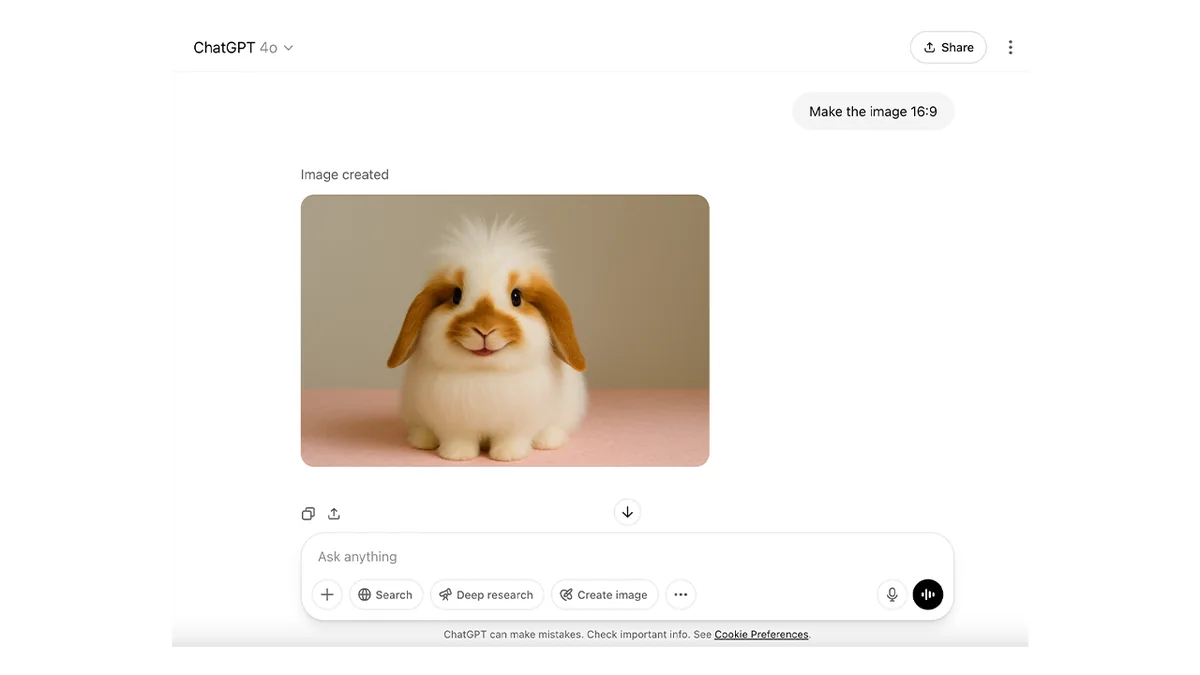
Old scheme (2023 to early 2025). ChatGPT was a text model that, when you asked for an image, called DALL-E 3 as an external tool. In practice ChatGPT wrote a prompt and passed it to another system, which returned the image. Each image was born in isolation: if you asked for a change, the model often regenerated from scratch, because there was no real visual memory of the conversation. It worked, but it was a dialogue between two separate components.
Current scheme (from 2025). OpenAI brought generation inside the multimodal model. First with GPT-4o in March 2025, then with the GPT Image family (gpt-image-1, then intermediate versions, today gpt-image-2 as the flagship model). There is no longer an external tool to call: the model generates the image natively, remembers the conversation context, can refer to images you uploaded and iterates without losing consistency. When you ask “change the color of the jacket”, it now understands which image you are talking about.
This is where DALL-E 3 left the stage. As Wikipedia also states, in March 2025 DALL-E 3 was replaced in ChatGPT by native image generation. If you generate an image in ChatGPT today, you are not using DALL-E 3, even though many articles out there keep writing about it in the present tense. I show you how current OpenAI generation works in the dedicated guide on how to create images with ChatGPT.
The timeline: what happened, with dates
Here is the life and retirement of DALL-E 3 with verified dates, because this is the part almost no article tells correctly.
| Date | What happened |
|---|---|
| September 2023 | OpenAI announces DALL-E 3. |
| October 2023 | DALL-E 3 arrives inside ChatGPT. |
| November 2023 | Available through the OpenAI API (dall-e-3 endpoint). |
| March 2025 | In ChatGPT, DALL-E 3 is replaced by native image generation (first GPT-4o, then the GPT Image family). From this point on, you no longer use DALL-E 3 in ChatGPT. |
| November 14, 2025 | OpenAI notifies the deprecation of the dall-e-2 and dall-e-3 snapshots in the API. |
| March 4, 2026 | On Azure / Microsoft Foundry, DALL-E 3 is retired: existing deployments stop working, the documentation points to GPT Image. |
| April 21, 2026 | OpenAI launches gpt-image-2, presented as "ChatGPT Images 2.0", the current flagship generation model. |
| May 12, 2026 | The dall-e-2 and dall-e-3 snapshots are removed from the OpenAI API. From this date, a call to the dall-e-3 endpoint returns an error. |
| August 30, 2026 | OpenAI also removes the DALL-E GPT from ChatGPT, the preconfigured image-focused version: anyone who created images inside it must download them by this date. Generation stays for everyone through ChatGPT Images. |
The takeaway: in mid-2026 DALL-E 3 is not a product you can open and use. It is recent history, important, but history.
What DALL-E 3 did well (and where GPT Image surpassed it)
I want to be honest in both directions, because “the new one is always better” is a convenient but false shortcut.
Where GPT Image made a real leap. Text inside images is much more readable: where DALL-E 3 often produced garbled writing, GPT Image writes correct words and phrases with a high success rate (in some third-party tests the text rendering is clearly superior, a figure to be credited to those who measured it). On top of that, GPT Image handles real editing and inpainting, keeps face consistency better across multiple images, supports wider aspect ratios and reaches high resolutions. In third-party comparative rankings such as evaluation arenas, GPT Image models sit at the top (ELO scores around very high values are cited, but they are third-party measurements, so I report them as such).
Where DALL-E 3 remained pleasant. Here I am talking about community perception, not absolute truth. Many remember DALL-E 3 as faster: it generated in a few dozen seconds and returned several images at once, while the more refined native generation sometimes takes longer. And some find the style of DALL-E 3 more “artistic” and warm, and consider certain GPT Image outputs flatter or more photographic. These are common opinions among those who used both; I report them as community impressions, not as my own lab data.

DALL-E 3 vs GPT Image 2: the table

Here is the direct comparison, with DALL-E 3 in the past tense (endpoint shut down) and GPT Image 2 as the living reference.
| Aspect | DALL-E 3 (legacy) | GPT Image 2 (today) |
|---|---|---|
| Status | Retired: out of ChatGPT (Mar 2025), API removed (May 12, 2026), Azure off (Mar 4, 2026), DALL-E GPT removed (Aug 30, 2026) | Active, OpenAI flagship model (since Apr 21, 2026) |
| Architecture | Dedicated model, called by ChatGPT as an external tool | Native generation inside the multimodal model |
| Context memory | Isolated images, little consistency across iterations | Remembers the conversation and uploaded images |
| Text in image | Improved but often garbled | Much more readable and accurate |
| Editing / inpainting | Limited | Native editing and targeted changes |
| Face consistency | Weak across different images | Better |
| Resolution / formats | More limited formats | Wide aspect ratios, high resolutions |
| Perceived strength | Speed and style (community opinion) | Quality, control, text, consistency |
| How you use it today | No longer used | ChatGPT (native) or gpt-image-2 API |
Usage rights: what you can actually do with them
An important and often misunderstood question. On this, DALL-E 3 had a clear, user-friendly position, and the underlying logic still holds for GPT Image.
OpenAI assigns the usage rights to the user. OpenAI’s historic formula said, in essence, that the images you create are yours to use: you can reprint them, sell them, make merchandise out of them. So on the contractual level with OpenAI, if you generated them yourself in compliance with the policies, you can also use them for commercial purposes.
But watch out for copyright. A different question is whether you can protect that image as your own work. In the United States, the orientation is that a work generated purely by AI, without a substantial creative human contribution, generally cannot be protected by copyright. Translated: you can use it and sell it, but you can hardly stop someone else from taking it. If you need exclusivity, the human contribution (editing, composition, selection, retouching) becomes the part that makes the difference. Rules vary from country to country, so for sensitive uses a specific legal check is always advisable.
Then there is the content policy side: DALL-E 3 already refused to imitate the style of living artists on request and applied filters on sensitive content. These limits have remained, and in several cases have become stricter, in the current generation.
Pricing: DALL-E 3 (past tense) and GPT Image (today)
Here I tread very carefully, because pricing is the point where it is easiest to write old numbers and pass them off as current.
DALL-E 3 API pricing (historic, endpoint shut down). When the endpoint was active, the cost was per image: Standard quality cost roughly between $0.04 and $0.08 per image, HD quality between $0.08 and $0.12, depending on resolution. I write them in the past tense because today you can no longer pay them: the dall-e-3 endpoint no longer responds.
Today’s pricing (GPT Image). The living reference is GPT Image. OpenAI’s documentation, for gpt-image-1, indicated per-image tiers that vary a lot with quality: low level in the order of a few cents, medium level higher, high level that can reach several dozen cents per high-resolution image. For gpt-image-2 some aggregators report a wide range depending on resolution and quality, but these are third-party figures, so I treat them as estimates to be verified on the official pricing page at the moment you read this. A useful churn note: in June 2026 OpenAI deprecated the intermediate models of the family, with official shutdown dates: gpt-image-1 on October 23, 2026, and gpt-image-1-mini, gpt-image-1.5 and chatgpt-image-latest on December 1, 2026. The landing point is gpt-image-2.
Free. If you do not want to go through the API, the way is ChatGPT: the free plan generates images with a daily limit that OpenAI does not officially publish (in practice, a few per day). A paid plan (Plus, roughly $20 a month) gives more speed, priority and volume. For API users, some aggregators mention a small welcome credit on new accounts, but this too should be verified because it changes often.
A rule I always follow: if a price is uncertain or “historic”, I say so. Better one number fewer than one wrong number.
How to access it today (and what to do if you were looking for DALL-E 3)
Let’s do the practical part. If you are here because you wanted to generate images with DALL-E 3, here is what to actually do now.
In ChatGPT. Open ChatGPT, write what you want to see and let it generate. There is no magic command and no “DALL-E” tool to select: generation is native. If you want to make changes, you keep talking (“make the background nighttime”, “add a caption that says …”). You can find the full operational guide, with the free plan limits and prompt tricks, in how to create images with ChatGPT.
Via API. If you are developing something, do not call dall-e-3 anymore (it returns an error). Use the images endpoint with the gpt-image-2 model. The code logic is similar; what changes is the model and the quality and format parameters.
If you specifically needed the “DALL-E 3 style”. It is not coming back, that specific model is off. But you can get close by working the prompt well in ChatGPT (explicitly asking for an illustrative, warm, non-photographic style) or by evaluating other generators: the most generous free alternative today is Gemini with Nano Banana, and if you need maximum quality I wrote about how much Nano Banana Pro costs. In my guide to the 7 free tools I compare all the real alternatives, including what makes sense if you are after speed or a more artistic style.

In short
DALL-E 3 was an important model: it made the idea of writing a sentence and getting a coherent image feel normal, and it raised the bar on prompt adherence and text rendering. But in 2026 it is legacy. OpenAI moved everything to native generation inside ChatGPT and GPT Image (gpt-image-2), removed the dall-e-3 API on May 12, 2026, Azure retired it on March 4, 2026, and on August 30, 2026 it took the DALL-E GPT out of ChatGPT too, the last piece carrying that name. If you were looking for DALL-E 3 to get work done, the practical answer is: use GPT Image inside ChatGPT.
Want to learn how to use them for your brand?
Tools change every few months, as DALL-E 3 itself proved. If you want to stop chasing the news and build a visual workflow that stands the test of time, I will guide you: images, characters and AI commercials are my daily work. Discover my services or write to me directly and let’s see together how to use AI image generation for your project.
Sources
- OpenAI - Deprecations (model shutdown dates)
- Microsoft Learn - DALL-E on Azure OpenAI (retirement and migration to GPT Image)
- Wikipedia - DALL-E
- OpenAI - DALL-E 3 (announcement page)
- OpenAI - GPT Image models
- OpenAI Developer Community - dall-e-3 deprecation reminder
- Notebookcheck - DALL-E leaves ChatGPT on August 30 (download your images)
- Tom’s Guide - You have until August 30 to save your ChatGPT DALL-E images
Leave a comment
Comments are reviewed and approved before they appear.