
Higgsfield is an AI creation platform, not a model: it brings together the strongest video and image engines, Seedance, Kling and Nano Banana included, and builds on top the directing tools the models lack. Ready-made camera moves, character consistency from one clip to the next, clip extension, tools for deriving social content from long-form. You pay in credits, with a free plan for trying. I use it every day for reels, spots and short films: here you find how it works, what it costs and who it is worth it for.
If you make AI videos it will have happened to you too: choosing the perfect model for a scene and discovering it cannot hold the camera still, or that yesterday's clip character has a different face today. The problem is almost never the model: it is that the craft around it is missing. Higgsfield was born exactly there: it is the place where models are put in a position to work, with the directing already there. I spend my days there, and the projects I bring to competitions are all born inside it. If you want the complete picture of AI video tools, the map is the create videos with AI guide: this page is the zoom on the tool I use most.
The models generate. The platform is the set: directing, camera, consistency. It is the difference between a successful clip and a video you can edit.
What Higgsfield is (and why it is not a model)
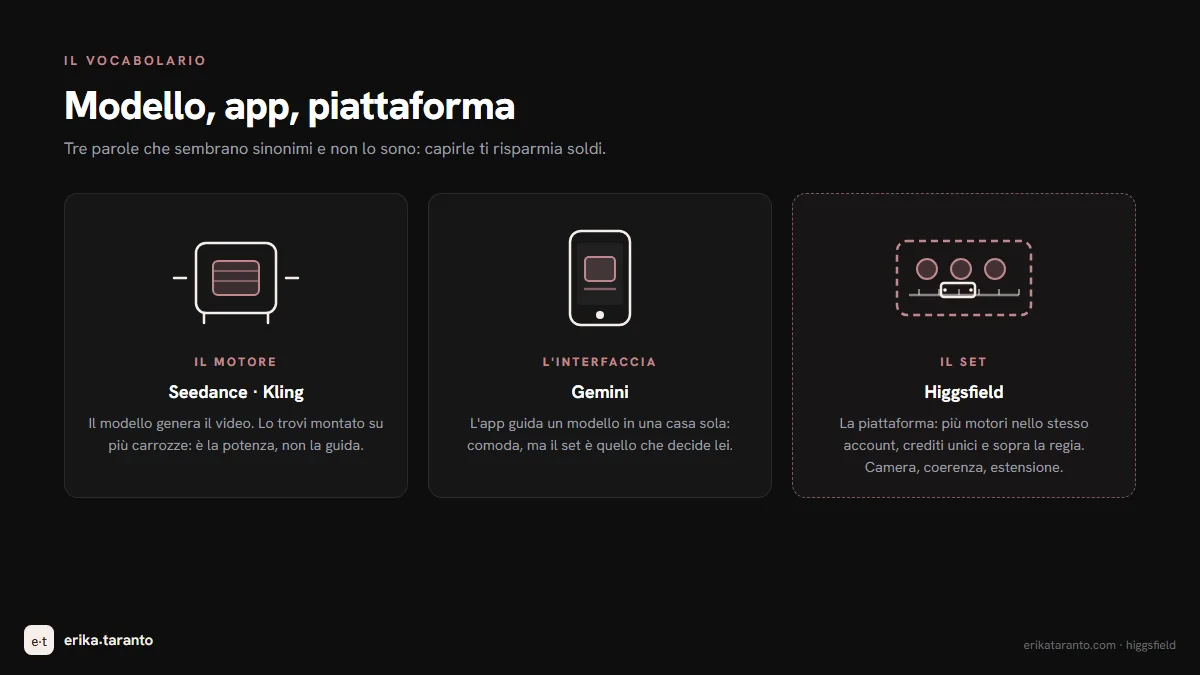
Let us start from the number one confusion, because it costs money to those starting out. Higgsfield is not an AI model: it is a platform. The model is the engine that generates the video: Seedance, Kling, Veo. The platform is the place where the engines work: it hosts them all in the same account, with the same interface and the same credits, and adds what the engine alone does not have, that is, the set method: ready-made camera moves to apply, character consistency from one generation to the next, extension of a successful clip, editing of several shots into a single flow.
Behind it is a serious company, not a one week experiment. It was founded by Alex Mashrabov, who previously built the computer vision of Snapchat's AI features: in January 2026 Forbes reported 130 million dollars raised and a valuation around 1.3 billion. The number I care about is a different one, the one that does not make the news: the hours it saves. And that is why the platform won, in my week, over the single model subscription.
What is inside: models, directing and studio
The platform reads on three levels, and it is the right way to enter it.
The engines. For video, ByteDance's Seedance, today up to version 2.5 with its native thirty seconds, and Kling, the realist of the group. For images, Google's Nano Banana Pro and Nano Banana 2 (which I explain well in this post), GPT Image, Seedream, and the in-house Soul and Soul Cinema models, tuned for the cinematic look: I use them for key frames and they cost very little, eight images for one credit. The catalog changes constantly, and that is part of the value: when a new model comes out, you find it at home without another subscription.
The directing. It is the level that made me stay. Ready-made camera moves, from dolly to orbit to push-in, applied with a click instead of described and hoped for. Character consistency, which keeps the same face from one clip to the next starting from the references. Clip extension, to lengthen a successful generation instead of redoing it. And multi-shot, which splits a long scene into shots that are consistent with each other.
The studio. Around the engines there is a small world for producers: the voice presets that clone a voice in about a minute, the Shorts Studio that derives about twenty verticals from a long-form, the Premiere Pro plugin, the prompt-based app builder. And since the end of August the Blender plugin, free: you block the scene in 3D with camera and timing, export the reference without spending credits, and Seedance executes the movement to the letter. I told it in the dedicated post, and it is the closest thing to real directing AI video has today.
The first afternoon is only for understanding where things are. The path I would give to anyone starting today:
- Create the account and look at the free credits. The free plan loads a few credits per day: enough for the first generations. Not enough for a project, and that is fine: first you learn to write, then you pay to produce.
- Choose the engine based on the scene, not the hype. The scene with three actions in a row goes on Seedance; the person walking and gesturing goes on Kling; the keyframe that has to look like cinema goes on Soul Cinema. In the main guide you find the complete table of who wins where.
- Write the prompt with the five elements. Subject, action, camera, light, audio, in this order and in one sentence. English works better: the interface is in English and the models train mostly there. My prompts always start in English, even for videos I then publish in Italian.
- Apply the camera from the panel, not from the prompt. It is the gesture that separates those using the platform from those using the model: instead of writing "cinematic camera" and praying, you pick the move from the panel (orbit, dolly, push-in) and the prompt stays free to describe the scene.
- Generate, watch, regenerate. The first version is almost never the good one, and it is not your fault: in my work I redo one clip in three. The advantage here is that every cost is written on the button before you press: you always know how much you are spending.
One last thing, said as a person not as an ad: it is the site where I spend my days, and I feel good there. If it were not so, this post would not exist.
How credits work (the part nobody explains)
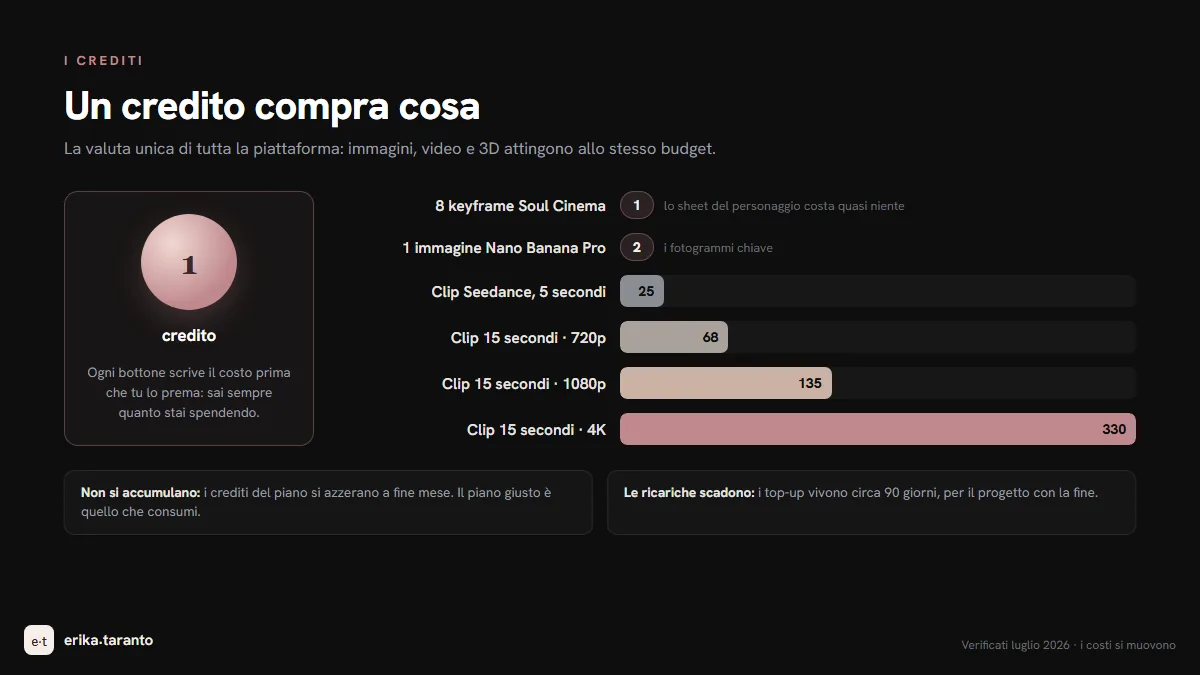
Credits are the single currency of everything: one budget consumed by images, videos, 3D. Every engine has its price per generation, so the same pack can become a thousand images or ten clips, depending on what you make it do. Concrete examples, verified in July 2026 and to be rechecked in the app because costs move: one Nano Banana Pro image about 2 credits; a basic five-second Seedance clip about 25; a fifteen-second clip about 68 credits in 720p, 135 in 1080p, 330 in 4K.
Two rules you need to know before loading the first work plan:
- Plan credits do not accumulate. They reset to zero at the end of the monthly cycle: it is a "use them or lose them" model, so the right plan is the one you consume, not the biggest.
- Extra top-ups expire. Top-ups live about ninety days: they are for a project with an end, not as a reserve.
How much Higgsfield costs: the plans
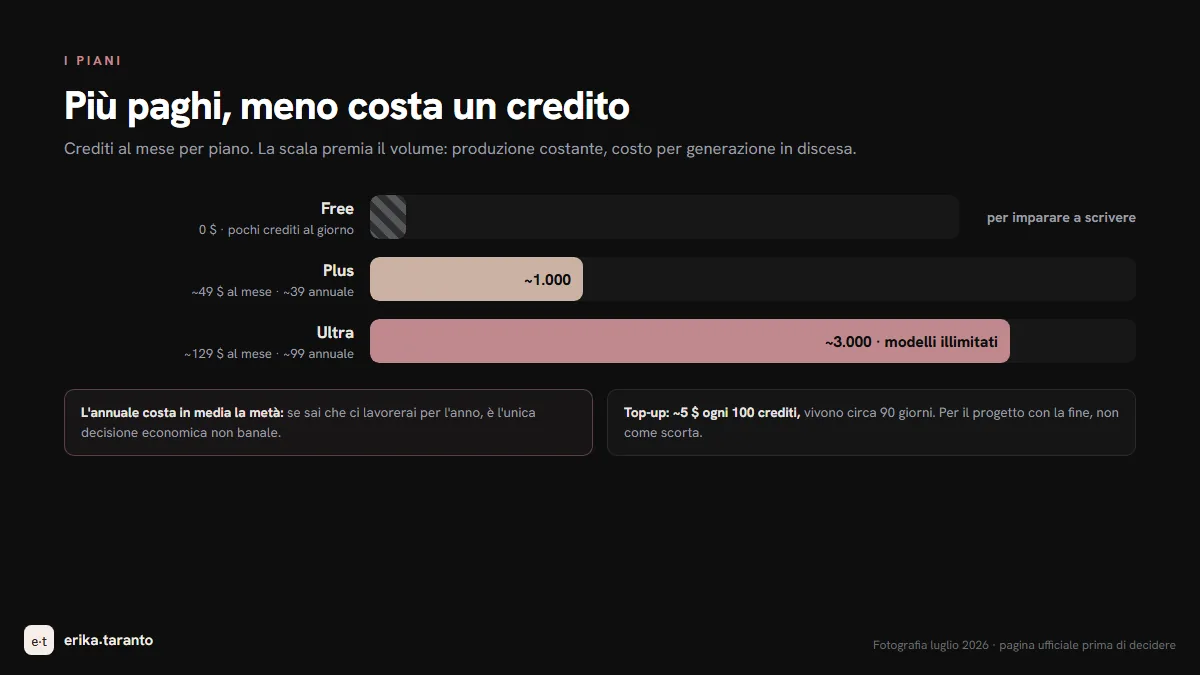
The structure scales with volume: the more you pay, the more credits per month, the lower the cost per credit, the more parallel generations, and on the high plans some models switch to unlimited use. The figures that follow are the July 2026 snapshot, and in this field the photo ages fast: before deciding, always the official pricing page.
| Plan | Credits per month (indicative) | Indicative price | What changes |
|---|---|---|---|
| Free | a few credits per day | 0 | Learning to write prompts, making the first clips |
| Plus | ~1,000 | ~$49 per month, ~$39 if annual | Light production: reels and clips for social |
| Ultra | ~3,000, scalable | ~$129 per month, ~$99 if annual | Some models in unlimited use, more parallelism |
| Team | per seat | on request | More people, more credits, centralized management |
The annual plan costs on average half the monthly one: if you know you will work on it for the year, that is the only non-trivial economic decision on the whole page. There are also day windows, the promos that open unlimited use on one model for a week: I always look at them the way I look at low cost flights, because the window is only worth it if your project fits inside.
The workflow I use every day
I will spare you the theory: this is the complete round of one of my projects, from the first image to the edited video.
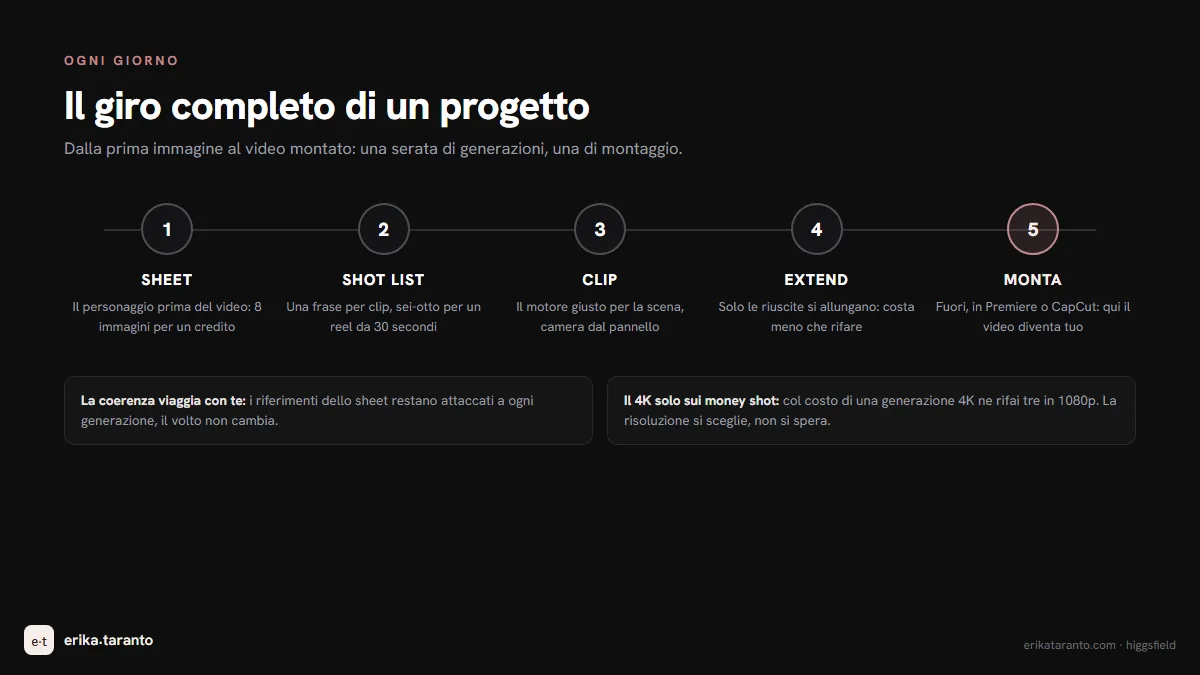
- I build the character before the video. I generate the sheet: the same person from far away, up close, from the side, three quarters. With the in-house image models it costs almost nothing, eight images for one credit with Soul Cinema.
- I decide the shot list, one sentence per clip. Six to eight sentences for a thirty-second reel. Every sentence is a shot, with its declared camera.
- I generate the clips with the right engine for the scene, with character consistency attached to the sheet references. The camera is chosen from the panel, not from the prompt.
- I extend only the successful clips. If a clip is good and needs to be longer, I extend it: it costs less than redoing it from scratch and the edit stays identical.
- I edit outside. The platform generates, the editing I do in Premiere (or CapCut for quick reels): cuts, voice, subtitles, end card. No platform gives you the edit, and that is how it should be: it is where the video becomes yours.
One evening of generations and one of editing: with this round I have brought short films to competitions and built reels for clients. If you want to see where the method arrives, the UNSEEN case study shows the complete film, behind the scenes included.
I use Higgsfield every day and I recommend it, so I owe you the real cons, not the facade ones.
- Credits expire. It is the point that burns everyone most: you finish the cycle and start from zero. If you produce in waves, one full month and one empty, you feel it. Countermeasure: size the plan on the full month.
- The learning curve is directing, not software. The interface is learned in an afternoon; what takes weeks is deciding the shots. The platform does not make you a director, it gives you the set.
- The interface is in English. No drama, but if English holds you back, know it beforehand: prompts also work better in English.
- The daily quota exists on paid plans too. Beyond a certain volume of generations per day, the system falls back on the fast model. If you have an intense production evening, better to spread it out.
- Names and prices change often. Renamed plans, added models, window promos. It is the price of a platform that runs: everything you read here has the date next to it, and needs rechecking.
Who it is for (and who it is not for)
I will tell you without going around it, because it is the biggest saving I can give you.
It is for you if: you produce videos every week, for clients or for your own channels; you move across several engines because scenes ask for different things; you have a character that must stay the same; the time you lose regenerating is worth more than the credits.
It is not for you if: you need one clip a month. In that case Kling's free plan with its daily credits, or Gemini for images, cost you patience and not money: the complete free routes are in the free AI video generators guide. And if you do not yet know which scenes you want to shoot, first the main guide, then the tool.
And if you need the video for your brand and prefer to have someone who does it every day: that is my craft. Write to me and we start from an idea.
The guides of the video path
- Create videos with AI, the map of all the tools (the pillar of this guide);
- Higgsfield enters Blender, the free plugin that brings 3D directing into the workflow;
- Seedance, the engine I use most inside the platform;
- Kling AI, the realist, and the best free school;
- Sora 2, the storyboard pioneer, which lives outside the platform;
- Free AI video generators, all the ways at zero cost.
If you arrive from the world of images, the same road is already done: start from creating AI images for free.
Sources
- Higgsfield, prices and plans: higgsfield.ai
- Official Higgsfield blog: geo.higgsfield.ai
- Forbes, January 2026 funding round: forbes.com
- ByteDance Seed, Seedance 2.5: seed.bytedance.com
- Alex Mashrabov, founder: linkedin.com
- Per-generation costs and credit behavior: verified in the platform in July 2026, and on the Blender plugin post in August 2026
For updates and news, there is my Telegram channel
I publish the latest news on AI video tools there first.
Leave a comment
Comments are reviewed and approved before they appear.