
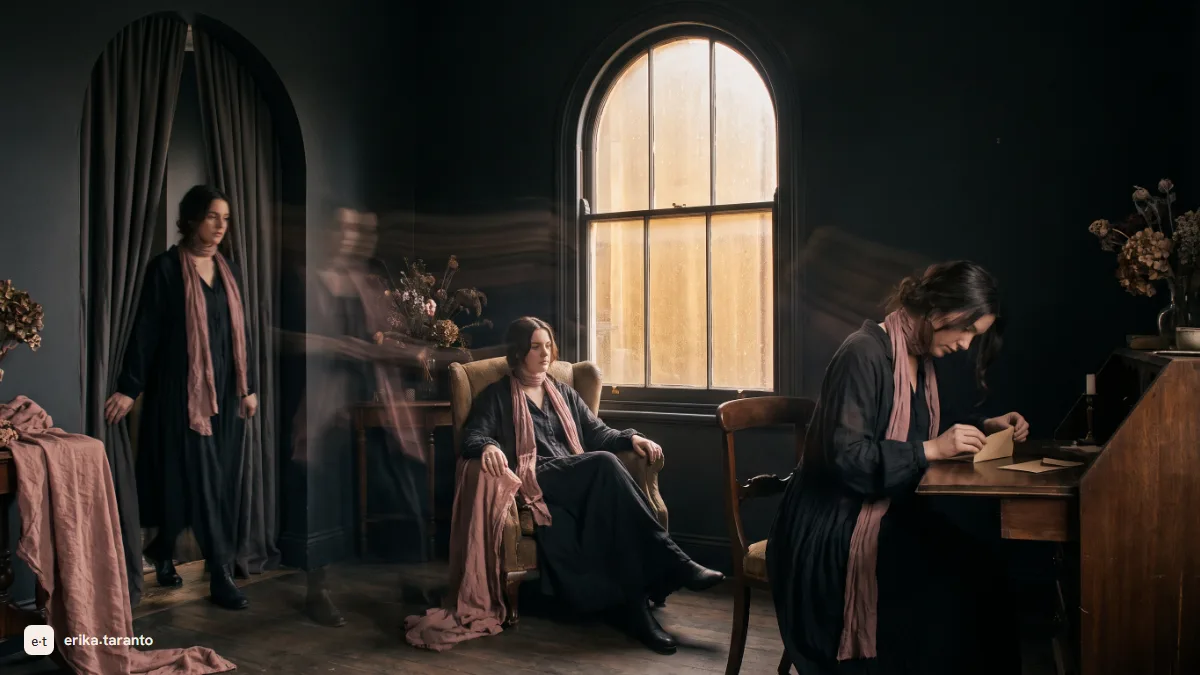
Seedance is the video generation model of ByteDance, the company behind TikTok and CapCut, developed by its Seed research team. Among the five big engines it is the one that follows long prompts with several chained actions best: where the others lose a piece of the scene along the way, Seedance remembers them all. The current version, Seedance 2.5, reaches thirty seconds in a single generation and accepts up to fifty reference images. You try it free via Dreamina, CapCut's creative platform, and you use it in production inside the platforms that host it: I use it mostly in Higgsfield.
All video models can shoot a shot. Few can shoot a scene. The difference is this: the shot is a woman at a cafe table; the scene is the woman entering, sitting down, ordering and opening the newspaper, in this order, without the order getting lost. Seedance is the engine I call the interpreter, because it reads the scene whole and performs it whole: the others, when the scene has three things that must happen in sequence, sooner or later forget one.
It is also the engine I use most inside the platform where I work every day. This guide is the zoom on it: the complete map of the five engines is in create videos with AI.
Everyone can shoot the shot. Not the scene: for that you need an engine that remembers what comes next.
What Seedance is (and whose it is)
Seedance is a text-to-video and image-to-video model developed by ByteDance, the Chinese giant behind TikTok and CapCut, in its Seed research team, the one handling the company's generative models. Born as a video model in 2025, it has been updated at a fast pace: version 2.5 is the one just released and the one I talk about here.
Seedance's place in my toolbox is precise: it is the interpreter of texts. When the scene is written well, with several actions following each other, Seedance reads it all and returns it all. If you write scenes, not single moving images, you will love it: it is the engine that treats your prompt as a script instead of a suggestion.
The problem it solves: the piece lost along the way
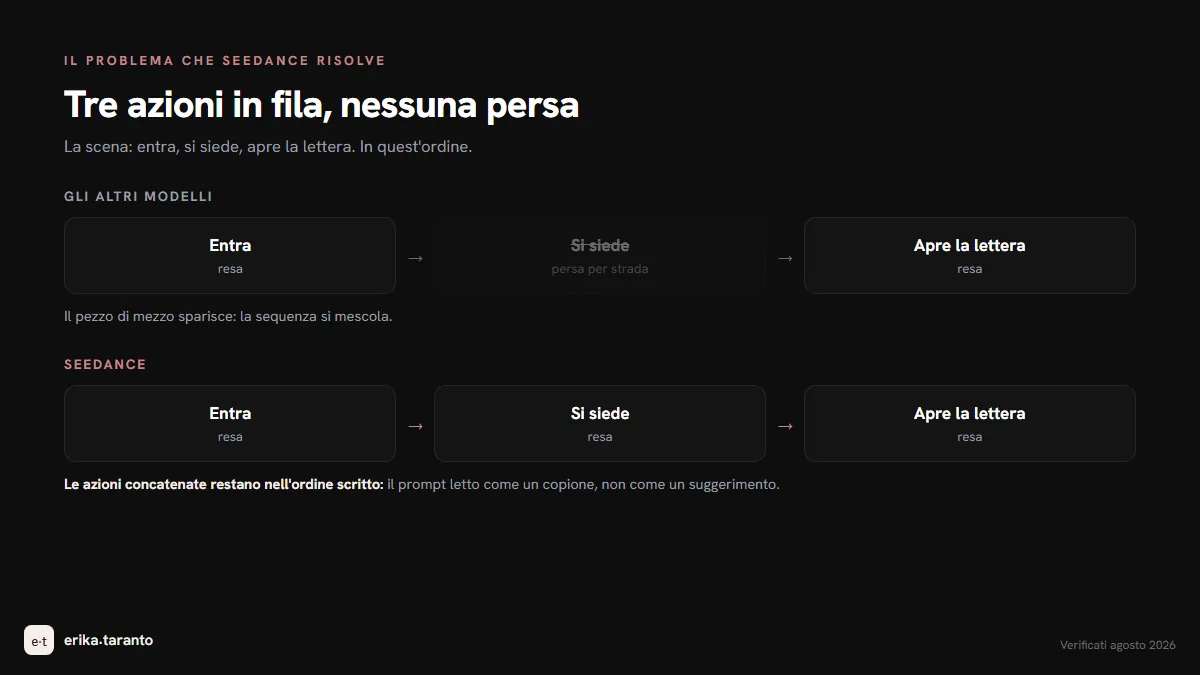
The flaw all of us who make AI videos know: you ask for three actions and the model returns two, or mixes them. Enter, sit down, open the letter becomes enter, open the letter, and the chair disappears. On engines that think in shots it is almost physiological: the model favors the most beautiful scene, not the requested sequence.
Seedance tackles the problem at the root, and in my working weeks it holds: chained actions stay in the written order. It is the reason narrative scenes, where one gesture prepares the next, go through here: in a spot where the hand picks up the product, turns it and sets it down, the order is the message.
Seedance 2.5: thirty seconds and fifty references
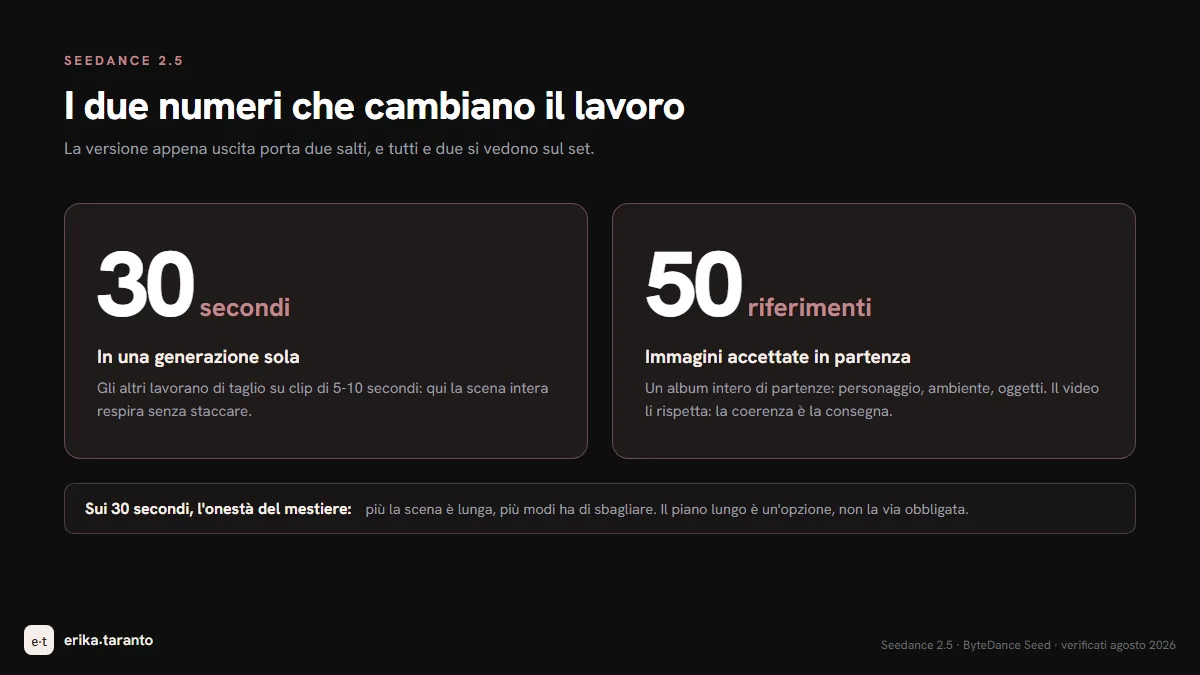
The version just released made two leaps that count, verified in August 2026:
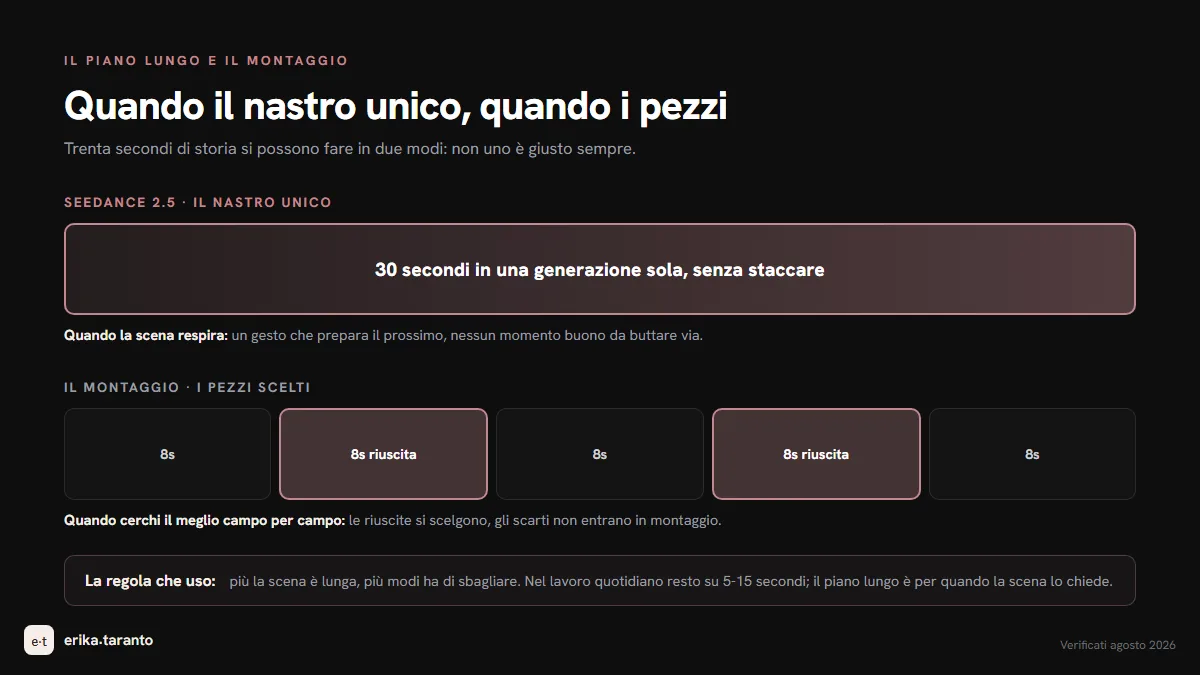
- Thirty seconds in a single generation. The other engines work by cutting: five to ten second clips that then get edited. Seedance 2.5 can hold a whole scene in a single thirty-second shot, with all that means for storytelling: the scene breathes without cutting.
- Up to fifty reference images. You can give the model a whole album of starting points: the character, the environment, the objects, and the video respects them. It is the function that changes the work on projects with brands and recurring characters, where consistency is the delivery.
On the thirty seconds, the honesty of the craft: the longer the scene, the more ways the model has to get it wrong. The long take is one more option, not the mandatory road: the best results are still often born on medium durations, and you choose shot by shot.
Where you try it free
You do not subscribe to Seedance directly: it is an engine, and engines live mounted inside apps and platforms. Two roads to begin:
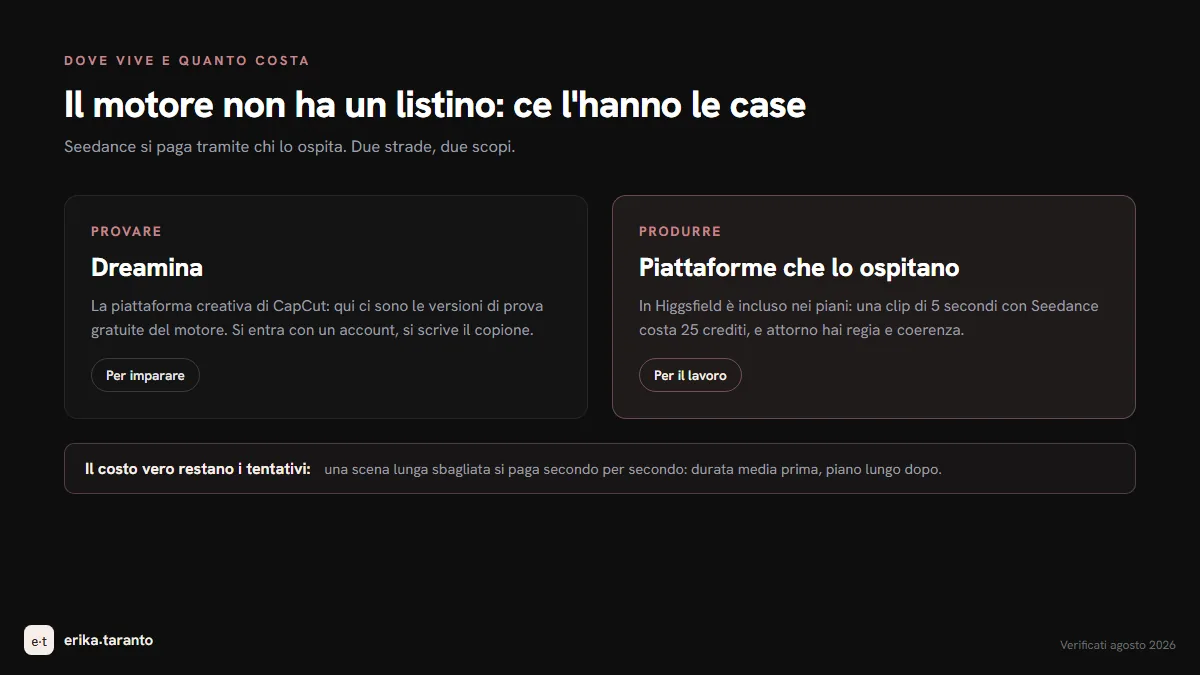
- Dreamina, CapCut's creative platform: it is where the free trial versions of Seedance are. You create the account, write the scene and see what kind of interpreter it is, without paying anything.
- Higgsfield and the platforms that host it: to produce seriously I log in from higgsfield.ai, where Seedance is included in the plans together with the other engines and the directing tools. The complete guide to the platform is here.
How to use it: the first scene in five steps
- Open Dreamina and choose video generation. Free account, no card: you are in to try.
- Write the scene like a script, not like a list. Below I leave you the exact format I use, with the actions in order.
- Upload the references if you have them. The character, the environment, the brand's object: on Seedance references are not an oracle, they are concrete starting points the video respects.
- Choose the duration with judgment: try the scene on a medium duration, and only when the script holds ask for the long take. Thirty seconds of mistakes cost like thirty seconds.
- When you produce for work, move to the platform: in Higgsfield Seedance stands next to Kling and the directing tools, and the flow of several clips with the same consistency gets managed without jumping between four sites.
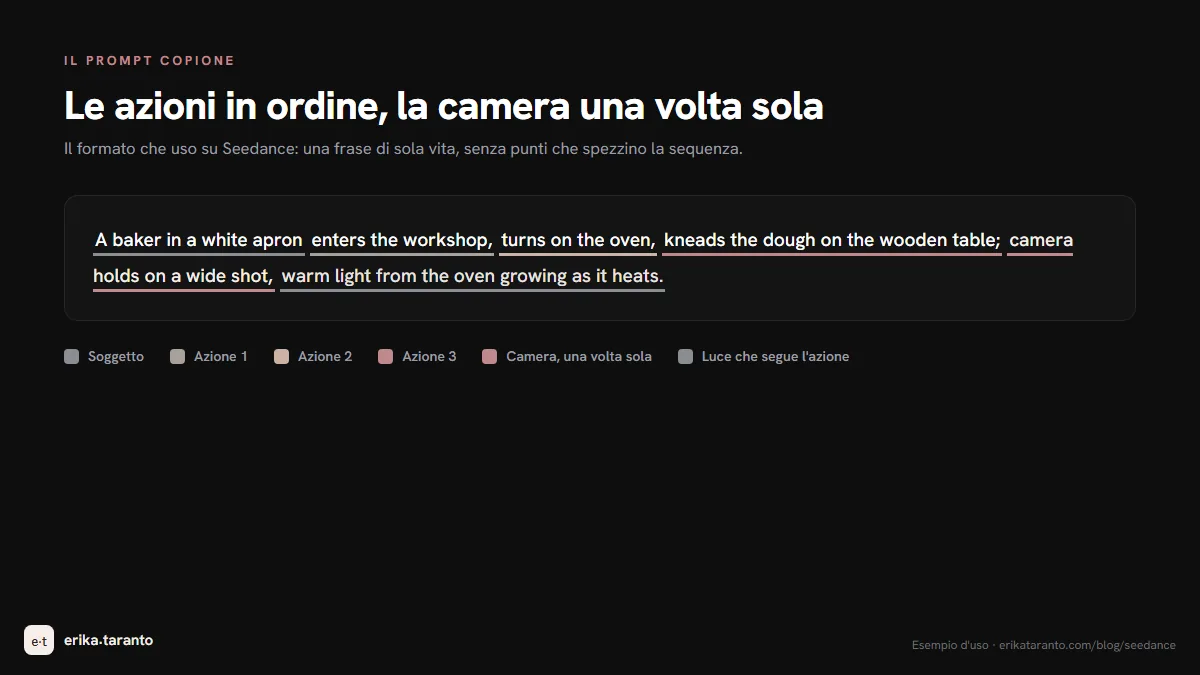
The format I use, designed for the engine's strength. The actions in order, connected, one camera declared once:
A baker in a white apron enters the workshop, turns on the oven, kneads the dough on the wooden table; camera holds on a wide shot, warm light from the oven growing as it heats.
Note how the three actions sit in one sentence: enters, turns on, kneads, in this order and without periods and line breaks the model could read as separate scenes. The camera sits at the end, declared once: wide shot, still. The light has a logic that evolves with the action (the oven lighting up as it heats): it is the kind of detail Seedance picks up and uses.
The general rules of the video prompt, including the traps, are in the dedicated section of the main guide: one sentence, five elements, no negations. On Seedance you add the script rule: actions in order, tied by a single syntax.
How much Seedance costs
Seedance has no price list of its own: the price depends on the house you mount it in. The picture, verified in August 2026:
| Road | What you pay | When it makes sense |
|---|---|---|
| Dreamina (CapCut) | free trials of the engine, then Dreamina's plans | Trying, learning the script |
| Platforms that host it | included in the plans: in Higgsfield a 5-second clip with Seedance costs 25 plan credits | Producing every week |
| No direct subscription | the "Seedance plan" does not exist: the engine is paid through whoever hosts it | To know before searching for it |
The comparison with the plans of Veo, Sora and Kling, with all the numbers together, is in the costs section of the main guide. And the rule always holds: the real cost is the attempts, and a wrong long scene is paid for second by second.
The honest limits
- Body physics. It holds the sequences, but a body that must look alive in a difficult gesture, a dance step, a run, I send to Kling: that remains its ground.
- Directing precision. If the shot is written to the millimeter, Veo 3 executes with more fidelity: Seedance favors the sequence, Veo the description.
- The long take is at growing risk. Thirty seconds are an option, not a promise: the longer the generation, the more corrections cost. In practice I alternate durations.
- It has no house of its own. Whoever searches "the Seedance website" finds the Seed team's blog, not an app: to use it you go through Dreamina or a platform. It is not a flaw, but it has to be known.
- English pays double. It accepts Italian, but script prompts work better in English, where the model distinguishes the sequence of verbs better.
When I choose Seedance, and when not
Seedance takes the scenes written as scripts: several actions, sequences, long take when needed. The rest I assign like this:
- the shot to the millimeter: Veo 3;
- the living body, gestures and walks: Kling;
- whole projects with consistency, camera and social formats: Higgsfield, where Seedance is the engine I use most.
And if the scene you have in mind is for your brand and you prefer to have someone who writes scenes every day: that is my craft. Write to me and we start from an idea.
The guides of the video path
- Create videos with AI, the map of all the tools (the pillar of this guide);
- Higgsfield, the platform where Seedance works with the directing around it;
- Veo 3, the engine that executes the written scene;
- Kling AI, the realist, and the best free school;
- Sora 2, the storyboard pioneer, today with competition on its heels;
- Free AI video generators, all the ways at zero cost.
Sources
- ByteDance Seed, Seedance 2.5, official announcement: seed.bytedance.com
- Dreamina, CapCut's creative platform where to try the engine: dreamina.capcut.com
- Higgsfield, the platform that hosts it in the plans: higgsfield.ai
- Maximum duration, references and cost in credits on the platforms: verified in August 2026, same check as the main guide
For updates and news, there is my Telegram channel
I publish the latest news on AI video tools there first.
Leave a comment
Comments are reviewed and approved before they appear.