
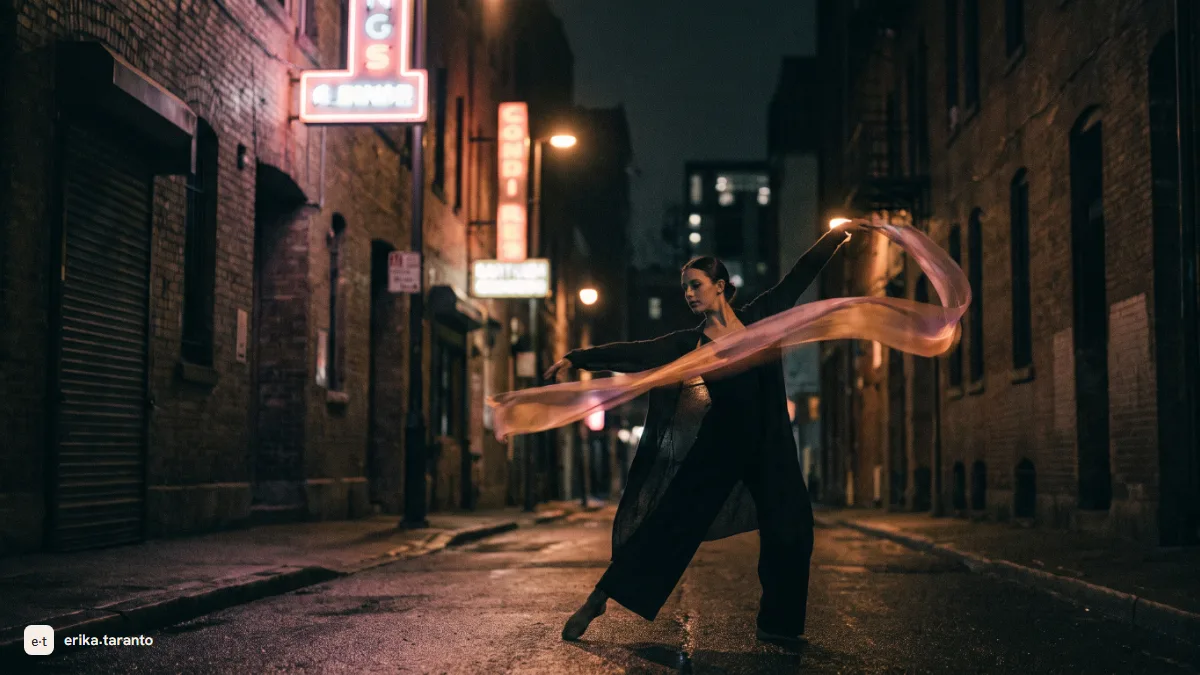
Kling AI is a video generation model by Kuaishou, the Chinese company among the giants of short video: from the latest releases of 2024 to today it has become the engine that moves people best, walks, gestures and body physics included. It generates clips of 5 or 10 seconds from text or image, it lives on kling.ai and inside directing platforms like Higgsfield. The free plan renews 66 credits every day (they do not accumulate), the first paid plan costs about 10 dollars per month with 660 credits. Here you find how to start, what to write in it, what it really costs and the honest limits.
If Veo is the director who executes the written scene, Kling is the actor. In my week, clips with human beings who must look alive, a woman walking the wrong way in the metro, a bartender drying a glass, go through Kling: where the other models move believable puppets, Kling moves bodies with weight. And it is also the place where you learn for free better than anywhere, because the credits come back every day.
This is the dedicated guide: the complete map of the five engines, with who wins where, is in create videos with AI.
The other models move believable puppets. Kling moves bodies: that is why all my scenes with living people go through here.
What Kling AI is (and why professionals have it)
Kling is a text-to-video and image-to-video model developed by Kuaishou, the Chinese company behind one of the largest short video services in the world. Presented in 2024, it has been updated at a fast pace since: the version I use today has almost nothing to do with the one that made a name for itself two years ago, and this is the first point for anyone evaluating: Kling is a living engine, changing every few months.
It made its fame on realism, and it is deserved on one precise point: human movement. Natural walks, hands grabbing objects, hair following the wind, the weight of a body sitting down. These are the hardest things for a video model, because one wrong frame is enough and the spell falls: Kling gets it wrong less than the others, exactly there.
The second reason professionals keep it at hand is the free plan, which arrives next.
The 66 credits a day: the best free school
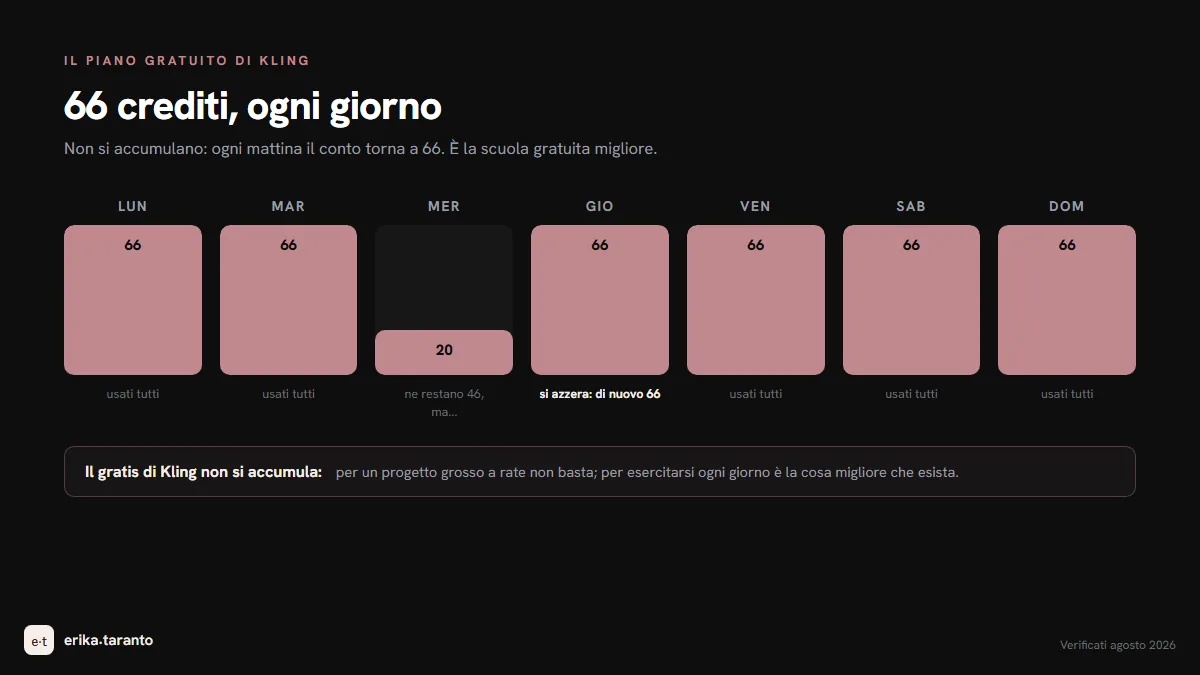
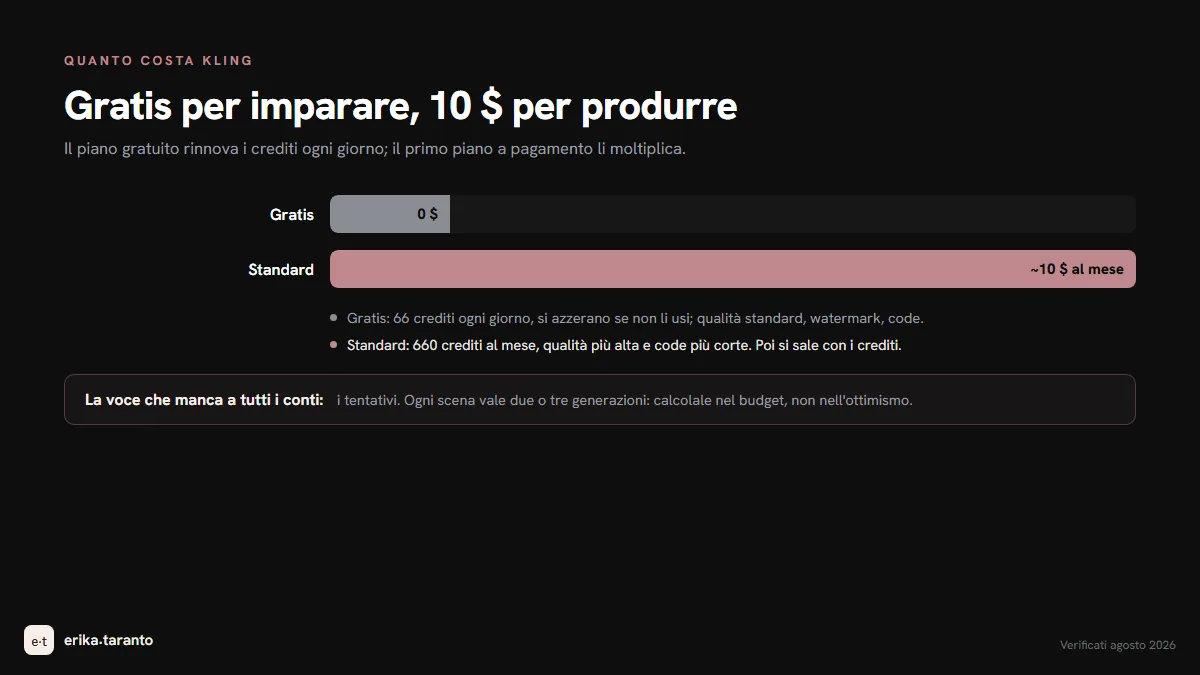
Kling renews 66 free credits every day. It is not a one-time bundle like elsewhere: every day the account goes back to 66, and you can generate in standard quality, with watermark and sometimes long queues.
The rule to know before organizing the work: unused credits reset to zero. If today you spend 20, tomorrow you do not have 112: you have 66. Kling's free tier does not accumulate, so you cannot build a big project on it in installments. But for learning, which is what matters at the beginning, it is the best school there is:
- every day you have new attempts, so you can practice seriously, with continuity, which is the only thing that teaches you to write prompts;
- the credits are enough for a few videos per day in standard quality: enough to understand whether the scene works before paying for it;
- when a scene deserves high quality, you redo it paid or bring it to a platform: the free tier is for the try, not for the delivery.
All the free routes compared, Kling included, are in the guide free AI video generators.
How to use it: the first clip in five steps
- Create the account on kling.ai: you need an email address, the interface is in English. From the start you have the day's credits.
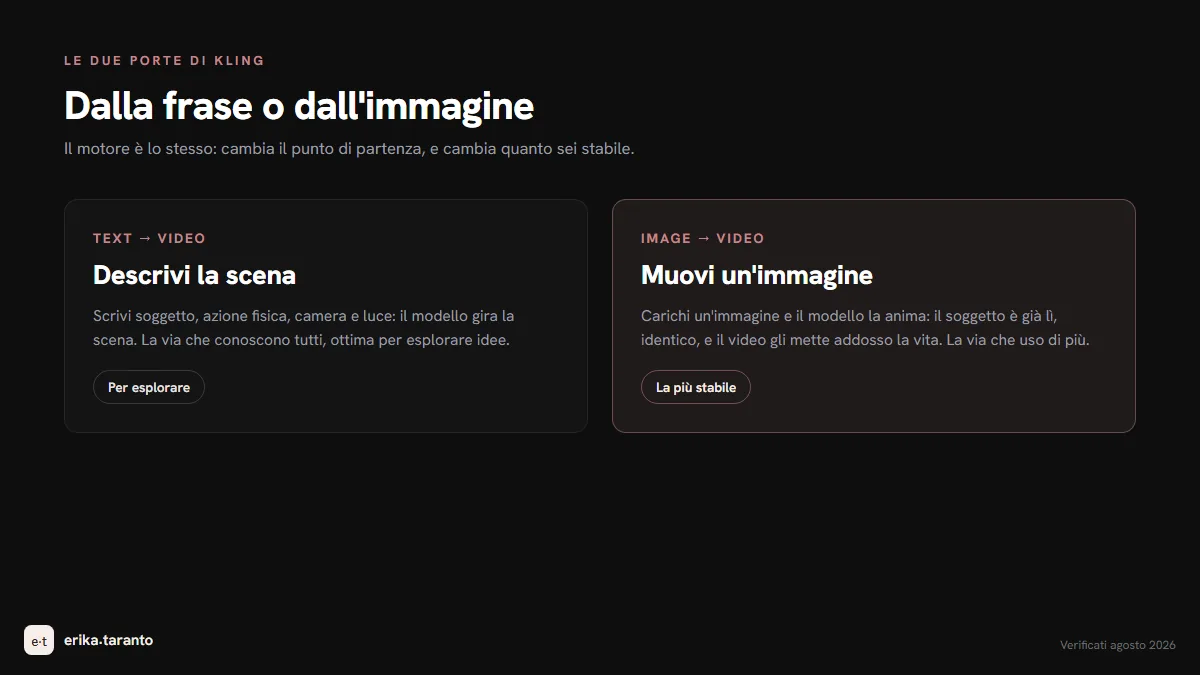
- Choose how to start: text-to-video, you describe the scene, or image-to-video, you upload an image and make it move. The second road is the one that gives the most stable results: a strong image does half the work.
- Write the scene with the body at the center (below I leave you the example): on Kling physics is the model's treasure, so the prompt must declare the movement, not only the atmosphere.
- Choose duration and quality: 5 or 10 seconds, standard or high. The try happens in standard, the successful one is redone in high: spending high quality right away on an untested prompt is the way to throw credits away.
- Extend when needed: if the clip works, Kling can continue the scene. If the project is bigger, with more clips and consistency to keep, I move to the platform: in Higgsfield Kling is already inside, with the directing tools around it.
The prompt on Kling: the body at the center
If on other engines the prompt is the scene, on Kling the prompt is the body inside the scene. The structure I use, with a real example from my folder:
A fisherman in a yellow slicker pulls a rope on a wooden pier, heavy rain, camera holds still on a tripod, cold morning light, waves hitting the posts.
Five pieces: who (declared in body and clothing), physical action (one only, with the effort declared: pulls, not interacts with), environment (the pier, the rain), camera (still: always declare it, or it wanders) and light (cold, morning). On Kling the physical piece pays double: pulls a rope generates arms, shoulders and weight working together.
The functions that make the difference
What distinguishes Kling from the other models, in the practice of every week:
- Start and end frame. You can give Kling the first and the last frame of the scene, and the model builds the movement between the two: it is the function I use most when the shot is already decided.
- Declarable camera moves. Tracking, pan, zoom: you choose them instead of hoping for them.
- Clip extension. The good scene can be continued, second after second, without starting over.
- Lip synchronization. You upload an audio and the face follows it: for reels with speech it is the shortcut that saves dubbing in post.
None of these functions is a toy: together they are the reason Kling, born as the Chinese surprise of 2024, is today a workhorse.
Figures verified in August 2026: the sector moves every month, recheck the plans page before deciding.
| Plan | What you get | Who it is for |
|---|---|---|
| Free | 66 credits every day, they reset to zero if you do not use them; standard quality, watermark, queues | Learning, trying scenes, getting confident |
| Standard | about $10 per month, 660 credits, higher quality, shorter queues | Producing every week for social and projects |
| Beyond | more credits and more functions as the plan goes up | Teams and high volumes |
The honest limits
- The queues of the free plan. At hot moments the standard generation can take quite a while: it is the price of free credits, and you pay it in waiting.
- Watermark and quality on the free tier. The free plan's videos come out branded and in standard quality: for work they get redone paid.
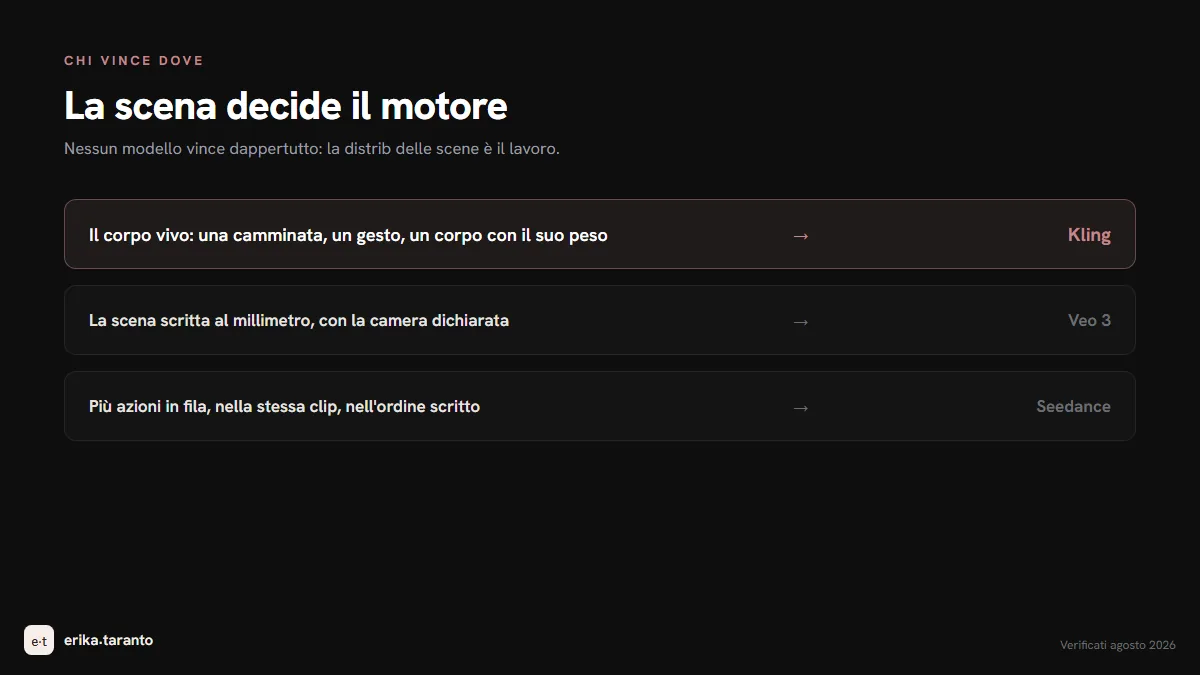
- Camera precision. It moves bodies better than anyone, but it executes directing with less fidelity than Veo: if the shot is written to the millimeter, that is not its home ground.
- The interface does not speak Italian. It accepts the prompt in Italian, but the interface is in English and the model follows English better: my prompts always start there.
- Scenes with several actions in a row. Three chained actions in the same clip are not its format: for those I use Seedance.
When I choose Kling, and when not
Kling takes the scenes where a body must look alive. The rest I assign like this:
- the already written scene, the camera to the millimeter: Veo 3 executes it with more precision;
- more actions in a row, long clips: Seedance remembers them all;
- whole projects with directing, consistency and social formats to manage together: Higgsfield, where Kling works with the tools around it.
And if you need the video with living people for your brand and prefer to have someone who does it every day: that is my craft. Write to me and we start from an idea.

The guides of the video path
- Create videos with AI, the map of all the tools (the pillar of this guide);
- Higgsfield, the directing platform where Kling lives with the other engines;
- Veo 3, the engine that executes the written scene;
- Seedance, the engine of long scenes;
- Free AI video generators, all the ways at zero cost.
Sources
- Kling AI, official website: kling.ai
- Kling AI, plans and credits: kling.ai/app/membership
- Higgsfield, the platform where Kling is included: higgsfield.ai
- Daily free credits and model behavior: verified in the app in August 2026, same check as the main guide
For updates and news, there is my Telegram channel
I publish the latest news on AI video tools there first.
Leave a comment
Comments are reviewed and approved before they appear.