
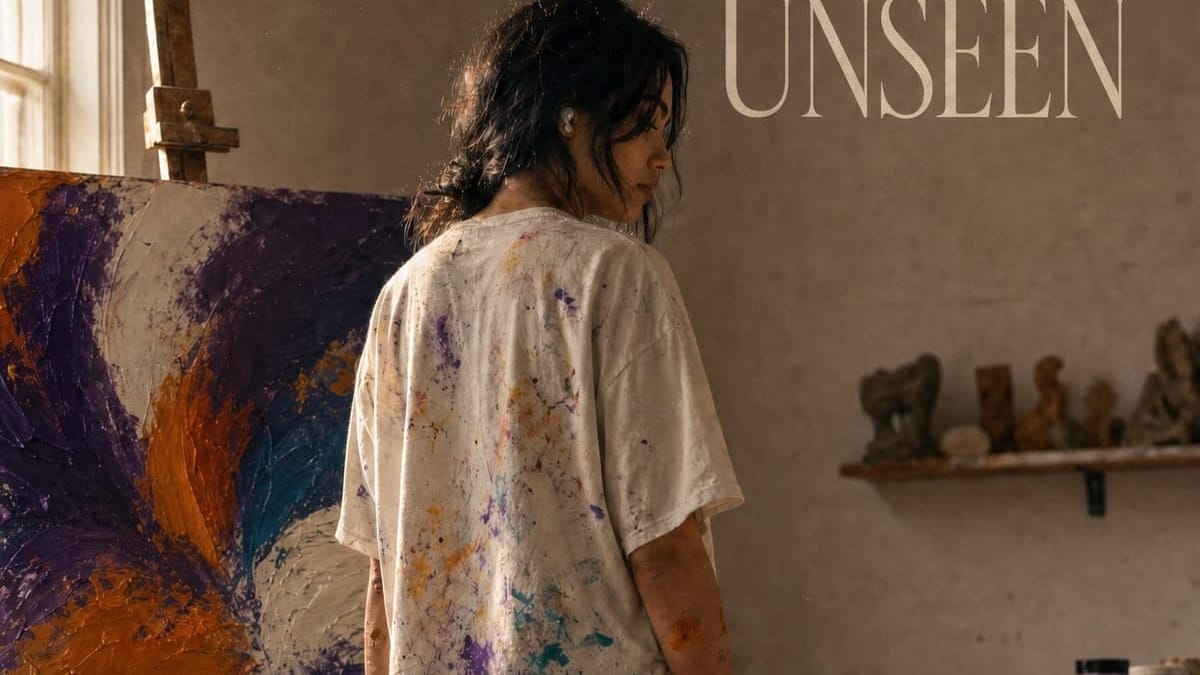
Behind the scenes of UNSEEN, the story of Iris, a blind painter, and of an artificial intelligence that learns to stand beside her. A film built alone, one shot at a time, selected among the ten finalists of the ITU’s AI for Good Film Festival 2026 in Geneva.
Where it all started
UNSEEN was born from a simple question: what does it mean to create something beautiful and never be able to see it.
The protagonist is Iris, a painter blind from birth. She paints with her hands, recognizes colors by smell and texture, mixes them by touch. She knows that thick means wet, dry means done. She has never seen her paintings: to know whether they are beautiful, she has always had to trust the words of others.
This is not a poetic invention. Real blind painters exist, like John Bramblitt and Esref Armagan, who taught himself color, light, shadow and perspective by “seeing” with his fingertips, to the point that Harvard scientists measured his visual cortex light up while he draws. Iris comes from there. And behind her is a number few people know: in the world 285 million people live with a visual impairment, 39 million are completely blind, and 90 percent of them live in low and middle income countries.
The film imagines what happens when a technology of today enters that room: an artificial intelligence that, through an earpiece, names the colors on the canvas while Iris paints. It does not give her back her eyes. It gives her back her canvas.
Iris and Leo
Iris is not alone. With her is Leo, an orange tabby cat who is her life companion, not a prop.
Leo has his own rules, and I cared about respecting them all the way, because a real animal does not behave like a scripted animal. He never climbs onto the work table: that is the sacred space of painting. He stays on the floor, on the stool, in Iris’s lap. When she, out of frustration, slams a jar, Leo does not leave with composure: he bolts away like a rocket, the way any frightened cat would.
And he walks over the paintings laid out to dry on the floor, leaving orange paw prints. Those prints are his signature. They are also the last image of the film, and that is where the heart of the whole story lies: the work was never only mine. Leo still signs the paintings.
Two voices, one human and one machine
UNSEEN has two voices, and it was one of the most important choices.
The first is Iris’s: intimate, low, slow, as if she were speaking to herself. The second is the AI’s, and I deliberately left it synthetic. I could have made it warm, almost human. I did not. I wanted it to be honest, for you to feel that it is a machine, because the dialogue of the film is exactly that between a person and a tool, without pretending the tool is something it is not.
“It doesn’t give me back my eyes. It gives me back my canvas.”
The moment that brings everything to the surface is a question Iris whispers: “Can you see what I feel?”. The AI does not answer. There is silence, and the beat of her heart. Then comes the line on which I built the entire film: “I still can’t see what I make. But now I know it’s mine. Not what I felt. What I chose.”
There is a directing choice I am particularly proud of. At the most emotional point, while Iris cries, the AI keeps describing facts with no emotion at all: “The purple curve reaches toward the center. About twenty centimeters.” The contrast says, in a few seconds, the whole meaning of the film. The AI does not feel. But it lets her feel.
How I really made it
UNSEEN is a short film of about four and a half minutes, produced alone, with generative AI as the main visual tool. But generative does not mean pressing a button and waiting for magic. It is the exact opposite: I directed every shot, chose every movement, discarded a great deal.
Production numbers: 97 videos generated, 61 used in the edit, 0 crew on set.
I built the images and movements with Higgsfield Cinema Studio and Kling. The two voices were made with ElevenLabs. Editing, rhythm and music (library, royalty free, not AI generated) in CapCut. No crew, no shooting, no major studio budget.
And here is the thing that interests me most, even beyond this film: a quality of storytelling that until recently required months and figures out of reach is today within the grasp of a single person who knows what they are looking for. The tool executes, it does not decide. The decisions all remain with whoever directs.
When I say alone, I mean this: the directing, the art direction, the technical execution and every single visual choice are mine. Behind the scenes, though, I was able to count on precious support. Oleksandr Moccogni worked with me on method: he helped me build the workflows to get the best out of the AI tools and to translate into practice ideas and concepts that, on my own, I would have taken much longer to ground. He did not direct any of the film. He made it simpler and faster for me to direct it, clearing the technical obstacles out of the way and leaving me free to focus on the story.
What I wanted to say
UNSEEN speaks about AI for Good in a literal way, because AI based visual assistance already exists today, and it is free: Be My Eyes, Seeing AI, Envision. The film closes exactly on this, on black, in silence: “For 285 million people, the canvas is waiting.”
But the message, for me, is simpler than a list of tools. It is the idea that technology, when it is done well, does not replace people: it gives something back to them. Independence, access, the chance to finally meet their own work. Restoration, not replacement.
Geneva
UNSEEN was selected among the ten finalist films of the AI for Good Film Festival 2026, out of more than 1,300 entries from all over the world. The festival is organized by the ITU, the United Nations agency for digital technologies, within the AI for Good Global Summit in Geneva.
The ten films will be screened together, on the big screen, on July 9, 2026, with a conversation between the directors and the jury.
It is a small film about something very real. I never thought it would make it this far. And I am happy that the first time the world looks at it, it speaks of those whom the world, usually, does not look at.
UNSEEN, a film by Erika Taranto. Technical support and AI workflows: Oleksandr Moccogni. AI for Good Film Festival 2026, Geneva. erikataranto.com
Leave a comment
Comments are reviewed and approved before they appear.