
Netflix recreated Gene Wilder's voice with artificial intelligence for a new show, with his family's approval. But Wilder died in 2016 and never got to have his say on AI. The real issue is not the technology, and it is not the money: it is who has the right to give consent on behalf of someone who is gone.
On 23 September “Wonka’s The Golden Ticket” arrives on Netflix, the reality show set in the chocolate factory, for the 55th anniversary of the 1971 film. The teaser is already online, and the voice guiding you through it is Willy Wonka’s: Gene Wilder, the original actor. Except Wilder died in 2016. His voice was recreated with artificial intelligence by the company ElevenLabs, with his family’s approval: his wife, Karen Wilder, said she is happy the show brings to a new generation the warmth and imagination he gave to that character.
As soon as the news came out, the reaction was the predictable one: outrage, “AI is disgusting”, “let the dead rest”. I work with these technologies every day, and I see it differently: the problem exists, but almost nobody puts it where it really lies.
It is not the AI’s fault
Recreating a voice is not bad in itself. Tributes to people who are gone have always existed: holograms at concerts, posthumous duets, archive footage in documentaries. When there is respect, and permission from those who have the right to give it, the public welcomes them with affection. AI is just the latest tool used to do it. The tool decides nothing: what decides are the hands and the intentions of whoever uses it.
So asking “can it be done?” is pointless. It can, and it can be done well. The only question that counts is another one: who had the right to say yes?
Same technology, opposite reactions
The last fifteen years are full of attempts like this. And every time the public decided with taste, not with the technology.
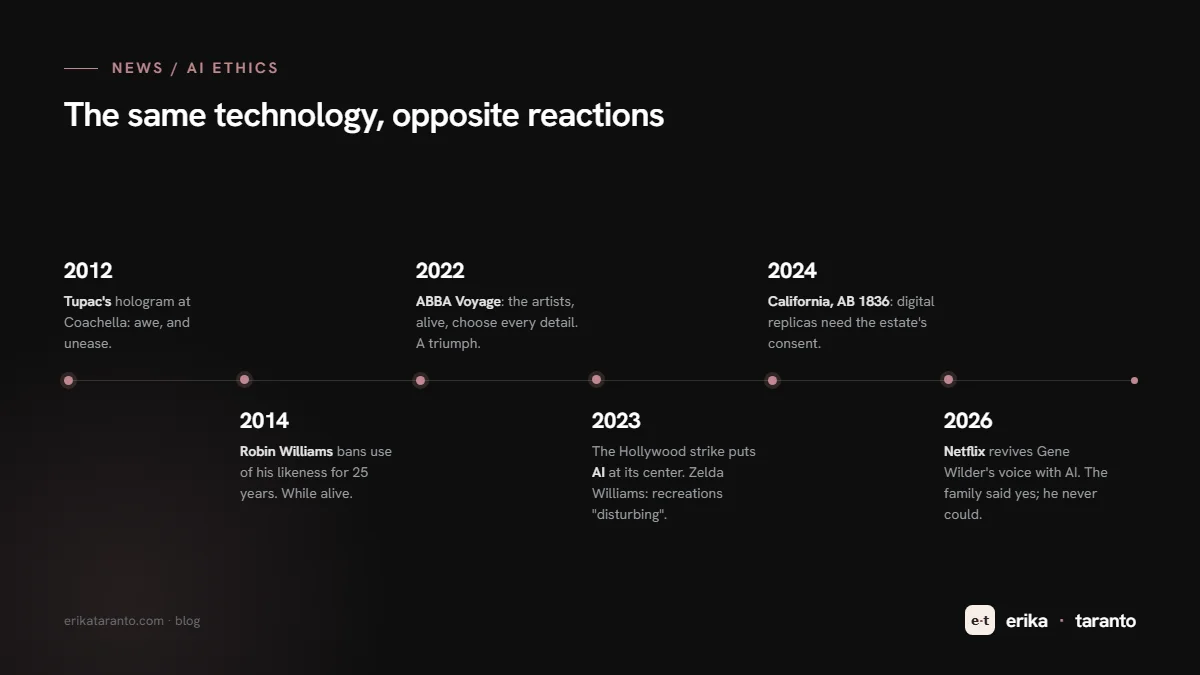
In 2022 ABBA filled an arena in London with “ABBA Voyage”: digital versions of themselves, young, singing every evening. A triumph, celebrated by the public and the critics. But there the artists were alive, they built the show themselves, they chose every detail.
In 2012 a hologram of Tupac appeared on the Coachella stage, in the final set of Dr. Dre and Snoop Dogg and with the heirs’ okay: a mixed reaction, amazement for some, discomfort for others. A Whitney Houston hologram had been authorized by her estate, which then stopped it at the very last minute, before its TV debut: they did not consider it worthy of an artist of that level. The Amy Winehouse hologram, authorized by her father, was postponed indefinitely after the criticism. And when Kim Kardashian was given a hologram of her dead father, for some it was a moving gesture, for others a disturbing intrusion into the memory of a man who could no longer have his say.
You can see the common thread too: when it worked, the yes had been given by the person, or by someone who truly respected her. When it left a bitter taste, that yes was not there. Everything else was identical.
Wilder could not say no. Robin Williams could
Back to actors, because here the contrast is sharp.
Gene Wilder never got to have his say on artificial intelligence, because when he died it did not exist. While alive he had criticized only the 2005 remake with Johnny Depp, which he called “an insult”, taking issue with Tim Burton’s direction and with Warner. The consent for the AI, today, came from his family. Not from him.
Now put him next to Robin Williams. Williams, in his 2014 will, banned the exploitation of his image, voice and name for twenty-five years after his death: until 2039. He did it while alive, before AI even became a topic, as if he had sensed it. His daughter Zelda today publicly asks people to stop generating artificial videos of her father, which she calls “personally disturbing”, and says she has already heard his voice made to say things he would never have said.
Two men, two opposite destinies. In one case the family decides. In the other the person decided, while there was still time. And here is the point almost nobody names: the family does not always choose what you would have chosen. Not out of malice. Out of a difference of thinking. Someone who loves you can decide in good faith something that you, if you could speak, would refuse.
It is not the money either
The first instinct is to say: “they only do it for the money”. A weak argument, and I enjoy taking it apart. Cinema is paid work: actors are paid to act, and nobody cries scandal. If money were the problem, the job itself would not exist.
The proof is Michael Caine. Sir Michael Caine, who is alive, sold his voice to ElevenLabs for an audiobook of the Odyssey, released in June: thirteen hours read by his recreated voice, free in the company’s app. Of his own free will. He chose, he signed, he got paid, and most people saw nothing wrong with it, even if some in the industry criticized him. What makes the difference is not the money. It is the fact that he was the one who decided.
The same technology can be a tribute or a lack of respect. What always makes the difference is consent.
The laws are coming, late
Until recently, no rule said who is in charge of these rights after death. Now something is moving. In California a law passed in 2024, AB 1836, bans creating the digital replica of a deceased actor or musician without the consent of the estate. Other states are moving too: Tennessee passed the ELVIS Act, designed specifically against voice cloning, and New York has long protected the digital replicas of deceased artists. And it is no coincidence that artificial intelligence was one of the central reasons for the Hollywood actors’ strike in 2023: the fear of being digitized and used without control, alive or dead.
It is a start, but a huge hole remains: the law protects those who have an organized estate, assets, lawyers. Ordinary people, that is, all of us, never talk about these rights. And yet our voice and our face are cloned with the same tools, today, on a phone.
Respect or exploitation: you recognize it at a glance
You do not need an ideological position, “AI yes” or “AI no”. A tribute made with respect, with a sincere purpose, to introduce an artist to those who were not there, is one thing. Exploiting the image of someone who can no longer say anything is another. You recognize it at a glance when you see it: the difference is not in the technology, it is in the yes.
While the voice is yours, you decide
The most useful lesson from Robin Williams is this: you can decide in advance. He did it when it sounded like science fiction. Today it no longer does.
You do not need to be a star. To clone your voice, one minute of audio is enough, I say it because I do it for a living: one minute, really. For the face, a handful of photos. It is worth thinking about it now: who do you want to manage your image when you are gone? Whether your voice can be used, and for what, and by whom? These are questions we already put in writing for the house and for savings. For our digital identity, not yet, but in a few years it will be normal, like a will.
Because if you do not decide while there is time, someone else decides for you. With the best intentions, maybe. But it will not be your voice choosing.
So the question I leave you with is not about Netflix, and not even about Gene Wilder. It is about you: when you are gone, who do you want to have the last word on who you were?
If you need AI in your work but do not want to chase every new thing, that is exactly what I do every day. Here’s how I work.
Sources
- Netflix Tudum - “Wonka’s The Golden Ticket: Release Date, Trailer, Gene Wilder Voice”
- Variety - “Gene Wilder’s Voice Resurrected by AI for Netflix’s Willy Wonka Series; Wife Gives Blessing”
- The Hollywood Reporter - “Willy Wonka Competition Show at Netflix Uses AI to Re-Create Gene Wilder’s Voice”
- The Hollywood Reporter - “Robin Williams Restricted Exploitation of His Image for 25 Years After Death”
- Deadline - “Robin Williams’ Daughter Zelda on AI Recreating His Voice: ‘I Find It Personally Disturbing’”
- Variety - “Michael Caine’s Voice to Narrate AI ‘Odyssey’ Audiobook”
Leave a comment
Comments are reviewed and approved before they appear.